2--What is a Microphone?
A microphone is an amazing thing. It actually transfers energy--right in the palm of your hand! It takes an acoustical energy (your voice or instrument) and turns it into an electrical energy. This electrical energy can then be recorded, amplified or otherwise altered in ways that the original acoustic sound wave could not. Amazing!A Basic Look at Microphones
One of the most asked questions is, "What kind of microphone should I use?" It all seems very confusing: Dynamic, Condenser, Ribbon, Electret, large diaphragm, cardioid, omni--so many technical words! Think of a microphone as a "backward" speaker: a microphone hears sound and transfers it into electricity. A speaker sees electricity and transfers it into sound. The technical terms are not understood equally by those of us who use microphones.Read on. We will help you sort out some of the mysteries.
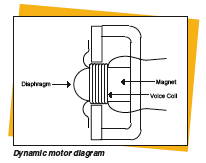
Dynamic Microphone
Dynamic microphones work on the "moving coil" principle. A small diameter of thin aluminum or Mylar diaphragm is connected to a coil of very thin hair like wire that is suspended in a strong magnetic field. As the acoustic sound waves hit this diaphragm, the coil of wire vibrates in the magnetic field causing an electrical signal to be produced. The electrical signal is the same frequency as the original sound wave.Tremendous mechanical durability, lower cost, no external power requirement and very high input SPL (Sound Pressure Level) capability were always the advantages of dynamic microphones. They are ideal for live events and concerts, in front of electric guitar cabinets, loud instruments (trombones, trumpets) and the like. They are ideal where rough treatment, such as at a school or church, is expected. Their lower cost makes it possible to own more mics so this is a big benefit to sound companies as well.
Typical dynamic microphone transducers are less than one inch in diameter. They have acoustical properties yielding frequency responses with peaks and dips in the wrong places, causing programs to sound either nasal or muddy or both. Excess equalization always had to be applied to electrically "fix" these poorly-designed dynamic elements.
The number one audio rule: You Can't Fix Acoustic Problems With Electronic "Fixes"!
In recent years, Heil Sound has brought new technologies in materials,
craftsmanship and design to the table for dynamics. In 2005, we introduced the
new PR Series of "large diaphragm dynamic mucriphones", addressing many of
the inherent problems of pervious dynamic microphones. They have dramatically
increased the transient response and the frequency response of our dynamic
to a point where it is possible to use a Heil PR mic instead of a condenser. This
new technology uses huge Heil 1.5 inch diameter diaphragms, very different
from the 1/2 to 7/8-inch diaphragms typically used in dynamics. These low mass
large diaphragms allow much faster transient response, something never heard
before in a dynamic. Precision location of the phasing plugs and a unique mixture
of rare earth metals in our motors (Neodymium, iron and boron) have created
the widest frequency response we've encountered in a dynamic.
These new Heil large diaphragm dynamic mics offer a natural, smooth midrange response
that has traditionally been the domain of ribbons. Heil mics are winning unique
praise in the studio, the live event and the broadcast booth, something not
readily seen or heard before. These new developments enable you to use a Heil
Dynamic where previously you would have only used a ribbon or condenser. The
Heil Dynamics are winning comparison tests everywhere so they are something
you should try! We were pleased to hear that Heil PR 30 and PR 40's are the
lead vocal mic on major studio projects and this is certainly quite unusual.
 Back To Home Page
 Back Up To The Top